If you’re searching for the latest AI innovation news, you’re likely trying to cut through hype and find out what actually matters. With breakthroughs announced almost daily—from next‑gen language models to AI-powered devices and enterprise automation tools—it’s easy to feel overwhelmed or unsure which developments will truly impact your work, investments, or everyday tech use.
This article delivers a clear, up‑to‑date look at the most significant advancements shaping the AI landscape right now. We analyze emerging tools, major product launches, research milestones, and real-world applications to help you understand not just what’s new, but why it matters.
Our insights are grounded in hands-on testing, technical analysis, and careful review of industry reports, developer updates, and expert commentary. The goal is simple: give you accurate, practical, and trustworthy coverage so you can stay informed, make smarter decisions, and confidently navigate the fast-moving world of artificial intelligence.
Beyond the Hype: What’s Really New in AI Right Now
First, let’s separate signal from noise. A breakthrough means a measurable leap in performance (for example, models solving complex math problems with higher benchmark accuracy), not just a flashy demo. Recently, multimodal AI—systems that understand text, images, and audio together—has made tangible gains in medical diagnostics and drug discovery. Meanwhile, robotics powered by real-time learning is moving from labs into warehouses.
So what should you do? Focus on tools with published benchmarks and real-world pilots. Follow credible AI innovation news, but verify claims against research papers. In short, prioritize substance over spectacle.
The Evolution of Generative AI: From Text to Worlds
Generative AI has moved far beyond simple chatbots. Today’s next-generation large language models (LLMs) are multimodal, meaning they can process and connect text, images, and audio at the same time. In simple terms, instead of just reading words, they can “see” pictures and “hear” sounds too. Another breakthrough is the long-context window—the amount of information a model can remember at once. Think of it like RAM for reasoning. Older systems could handle a few pages; modern ones can analyze entire books or massive codebases in a single pass (a game-changer for lawyers and developers alike).
Video generation has also leapt forward. Text-to-video systems, including Sora-level technology, now produce clips with realistic motion, lighting, and narrative flow. These models generate scenes that feel cinematic rather than stitched together. However, limitations remain:
- Inconsistent physics in complex scenes
- Difficulty maintaining characters over long sequences
- High computational costs
Still, progress suggests longer, more coherent videos are coming soon.
At the same time, specialized models are rising. These are smaller AI systems trained deeply in one area—like coding or legal research. Because they focus narrowly, they often outperform massive general-purpose models within their niche (quality over quantity in action).
Real-world impact is already visible in software development. AI copilots now review code, generate documentation, and debug in seconds, accelerating product cycles dramatically. For readers tracking AI innovation news, the shift is clear: we’re not just generating text anymore—we’re generating entire digital worlds.
AI in Science and Medicine: Solving Humanity’s Biggest Challenges

Artificial intelligence is no longer a lab experiment—it’s a lab partner. The real debate isn’t whether AI belongs in science and medicine, but how it compares to traditional methods.
Accelerated Drug Discovery: Years vs. Months
Traditional drug discovery can take 10–15 years and billions of dollars (Tufts Center for the Study of Drug Development). AI-driven platforms, by contrast, analyze massive datasets of molecular structures in weeks. In 2020, DeepMind’s AlphaFold predicted protein structures with near-experimental accuracy, solving a 50-year-old biology challenge (Nature, 2021). That’s the difference between manual trial-and-error and algorithmic pattern recognition.
Critics argue AI-generated candidates still require clinical trials—true. But if AI narrows 10,000 compounds to 20 viable ones, researchers save years. (Think of it as Google Maps for molecules instead of wandering with a paper atlas.)
Advanced Medical Diagnostics: Human vs. Machine Precision
Radiologists are highly trained, yet AI imaging tools now match or exceed human accuracy in detecting breast cancer in mammograms (Google Health, 2020). AI systems flag subtle anomalies invisible to the naked eye, enabling earlier intervention. Early detection often means higher survival rates—especially in cancers and neurodegenerative diseases like Alzheimer’s.
Skeptics worry about overreliance. Fair point. But side-by-side, AI + clinician outperforms clinician alone. It’s augmentation, not replacement. (Iron Man suit, not robot takeover.)
Material Science and Climate Modeling: Slow Simulation vs. Predictive Intelligence
Battery innovation once relied on slow lab testing. AI now predicts high-performance materials for solid-state batteries and solar cells before synthesis (MIT News, 2023). Similarly, AI-enhanced climate models process atmospheric data faster, improving extreme weather forecasts.
For readers tracking AI innovation news, the shift is clear: predictive systems outperform reactive ones. And as we’ve seen with major cybersecurity incidents and what they mean for users, proactive intelligence consistently beats damage control.
The comparison isn’t AI vs. humans. It’s outdated processes vs. accelerated insight—and the gap is widening.
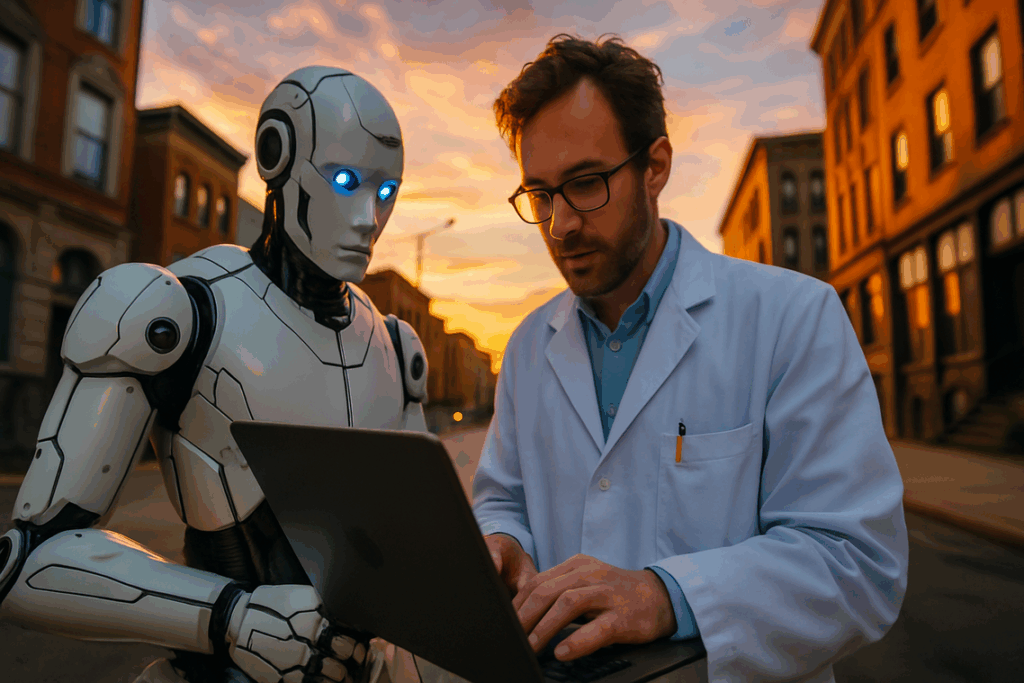
Embodied AI is no longer science fiction. Last year, I watched a humanoid robot fumble a coffee mug at a tech expo, then adjust its grip on the second try. That small recovery felt bigger than any flashy demo. It showed progress in dexterity (fine motor control of hands and fingers) and balance, two pillars of practical robotics.
The Leap Forward
Leading labs are now training robots through imitation learning, meaning machines learn tasks by observing human demonstrations rather than rigid code. Think of it as YouTube tutorials for robots (minus the ads). Improvements in joint torque control and real-time feedback loops let humanoids climb stairs, sort tools, and even fold laundry. PROGRESS IS TANGIBLE.
Beyond self-driving cars, autonomous drones now inspect bridges and deliver medical supplies using advanced navigation stacks that fuse LiDAR, cameras, and onboard reasoning models. In warehouses, mobile manipulators coordinate like silent coworkers, adapting to shifting inventory without constant human input.
The real breakthrough, though, is the software brain. Modern embodied models combine perception (understanding sensory input), reasoning (deciding what to do), and action planning in unpredictable environments. Recent AI innovation news highlights foundation models trained on multimodal data to ground language in physical action.
The Unseen Engine: Breakthroughs in AI Hardware
Next-gen GPUs now pack tens of billions of transistors, while custom-built AI accelerators like TPUs and NPUs offload matrix math with stunning efficiency. As a result, training times drop from weeks to days, and energy costs shrink dramatically. Meanwhile, optical computing pushes data through photons, promising processing at the speed of light—think sci-fi becoming spec sheet. Neuromorphic chips, modeled on spiking neural networks, mimic the brain’s low-power signaling, unlocking real-time edge AI. Together, these advances dominate AI innovation news, translating raw silicon gains into faster, greener, smarter systems. Pro tip: watch thermals.
How to Stay Ahead in the Age of AI
We’ve covered breakthroughs in generative models, scientific discovery, and robotics. Still, keeping up can feel overwhelming. So, start small. First, pick one workflow you use daily—email, research, or coding. Then, test a specialized AI tool that automates part of it. For example, use a code assistant to refactor legacy scripts, or a generative design app to prototype faster. Next, schedule 15 minutes weekly to scan AI innovation news and note one actionable idea. Finally, apply it immediately—learning sticks through use. By focusing on shifts, you’ll stay adaptable and relevant.
Stay Ahead in a Rapidly Evolving Tech World
Technology moves fast—and if you’ve made it this far, you were looking for clear, reliable insights to keep up. Now you have a stronger grasp of the latest trends, smarter buying decisions, and practical guidance you can actually use.
Falling behind on breakthroughs, missing key updates, or wasting money on the wrong tools is frustrating. In a world driven by AI innovation news, emerging gadgets, and constant software evolution, staying informed isn’t optional—it’s essential.
Here’s your next move: Don’t just read—stay connected. Bookmark us, explore our in-depth reviews, and dive into our step-by-step tutorials to keep your tech knowledge sharp. Thousands of readers trust us as their go-to source for accurate, up-to-date insights.
Stay informed. Stay competitive. Start exploring the latest updates now and make smarter tech decisions today.
 Marlene Schillingarin writes the kind of latest technology news content that people actually send to each other. Not because it's flashy or controversial, but because it's the sort of thing where you read it and immediately think of three people who need to see it. Marlene has a talent for identifying the questions that a lot of people have but haven't quite figured out how to articulate yet — and then answering them properly.
They covers a lot of ground: Latest Technology News, Emerging Tech Trends, Tech Tutorials and How-To Guides, and plenty of adjacent territory that doesn't always get treated with the same seriousness. The consistency across all of it is a certain kind of respect for the reader. Marlene doesn't assume people are stupid, and they doesn't assume they know everything either. They writes for someone who is genuinely trying to figure something out — because that's usually who's actually reading. That assumption shapes everything from how they structures an explanation to how much background they includes before getting to the point.
Beyond the practical stuff, there's something in Marlene's writing that reflects a real investment in the subject — not performed enthusiasm, but the kind of sustained interest that produces insight over time. They has been paying attention to latest technology news long enough that they notices things a more casual observer would miss. That depth shows up in the work in ways that are hard to fake.
Marlene Schillingarin writes the kind of latest technology news content that people actually send to each other. Not because it's flashy or controversial, but because it's the sort of thing where you read it and immediately think of three people who need to see it. Marlene has a talent for identifying the questions that a lot of people have but haven't quite figured out how to articulate yet — and then answering them properly.
They covers a lot of ground: Latest Technology News, Emerging Tech Trends, Tech Tutorials and How-To Guides, and plenty of adjacent territory that doesn't always get treated with the same seriousness. The consistency across all of it is a certain kind of respect for the reader. Marlene doesn't assume people are stupid, and they doesn't assume they know everything either. They writes for someone who is genuinely trying to figure something out — because that's usually who's actually reading. That assumption shapes everything from how they structures an explanation to how much background they includes before getting to the point.
Beyond the practical stuff, there's something in Marlene's writing that reflects a real investment in the subject — not performed enthusiasm, but the kind of sustained interest that produces insight over time. They has been paying attention to latest technology news long enough that they notices things a more casual observer would miss. That depth shows up in the work in ways that are hard to fake.