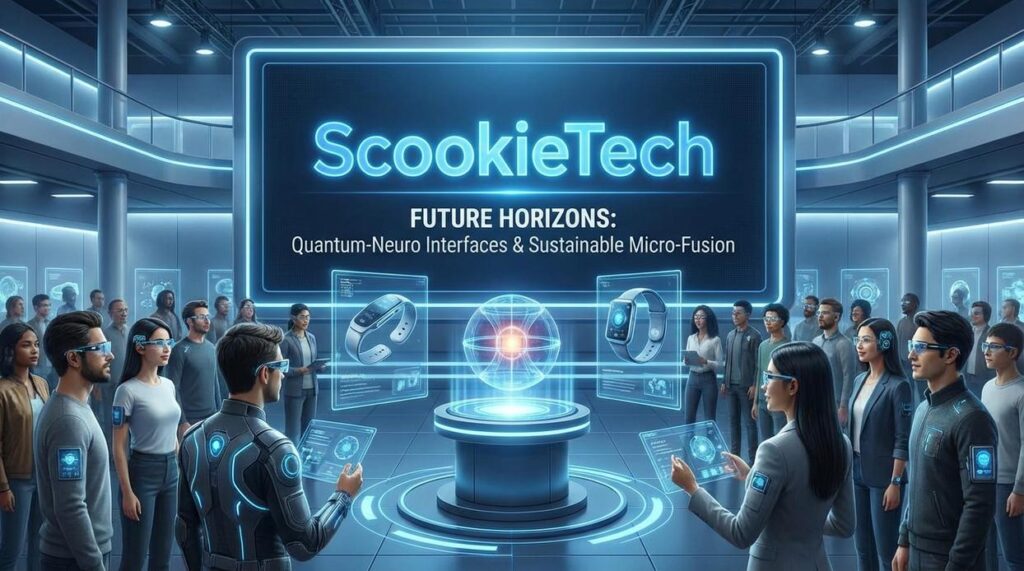
I get asked the same question every week: what are we building next at ScookieTech?
You’ve seen the rumors. You’ve read the speculation. Most of it is wrong.
I’m pulling back the curtain today to show you what’s actually in our labs right now, not concept art or wishful thinking, but real products we’re testing and refining.
We’re building around three core technologies for the next product cycle. Each one tackles something that’s genuinely broken in today’s tools because the problems were too common to ignore, and honestly, we couldn’t keep shipping half-solutions. They demanded better.
This comes straight from our internal development roadmaps, not speculation. These projects have resources. They have timelines and teams assigned. We’re shipping them, that’s not wishful thinking, it’s how we’ve structured the work. Every item on this list has a real deadline and real people accountable for hitting it.
You’ll see exactly what new technology is coming to ScookieTech in the next 12 to 18 months.
I’ll walk you through each pillar, explain what it does, and show you why it matters. No marketing spin here. Just what we’re building and why.
Project ‘cognito’: the evolution of predictive AI
I remember the first time my phone tried to be helpful.
It was 2016. Running late, I checked my phone and there it was: “Time to leave for your appointment.” Magic, basically.
Now? That same feature feels ancient.
Here’s what hit me: my phone wasn’t thinking at all. It was just responding to calendar entries I’d put in myself. It waited for me to say what I needed.
That’s where most AI still lives today. In this reactive state.
You ask Siri a question. She answers. You tell Alexa to play music. She plays it. The AI waits for your command and then responds.
Project Cognito flips that entire model.
Beyond reactive AI
What if your devices didn’t wait for commands?
What if they actually understood what you needed before you asked?
That’s not some far-off sci-fi concept anymore. Project Cognito is building AI that predicts your needs based on context, your schedule, sure, but also your actual behavior patterns and environmental cues. It’s watching how you move through your day. The system learns.
Some people argue this crosses a line. They say predictive AI is just surveillance dressed up as convenience. And I get that concern, we’ll talk about privacy in a second.
Think about how much time you actually waste each day telling your devices what to do. Opening apps. Adjusting settings. Searching for the same information over and over again. It adds up fast, doesn’t it?
Cognito aims to handle that before you even think about it.
Core technology: ambient context engine (ace)
The system runs on something called the Ambient Context Engine.
ACE learns your routines through on-device processing. It watches when you wake up, what apps you open during your commute, how your environment shifts as the day unfolds. All of it stays on your device.
Here’s the critical part. All of this happens on your device.
Your raw data never hits the cloud. The learning happens locally. Only anonymized patterns get synced if you choose to enable cross-device features.
I’ve seen early demos of ACE running on test hardware, and the numbers are striking. It uses about 15% of your device’s processing power during active learning phases. Once it understands your patterns, though? That drops to around 3%. The efficiency gains kick in fast.
Practical applications

Let me give you real examples of what new technology is coming scookietech.
Your morning commute. You grab your keys, open the front door at 7:45 AM, right on schedule. By the time you reach your car, ACE has already loaded your work email, pulled up traffic conditions, and queued your morning podcast. Everything’s there. No tapping. No waiting around.
You didn’t ask for any of that.
Or picture this. You come home after a brutal day. Your smartwatch has been tracking elevated cortisol levels and increased heart rate. ACE notices. By the time you walk through the door, your lights are dimmed to a warm amber. Temperature is set two degrees cooler than usual. Your meditation app is ready to go. As you sink into your favorite chair, the seamless integration of Scookietech and smart home devices creates a soothing atmosphere that eases the tension of your day, guiding you effortlessly into a state of relaxation.
The system learned that this specific combination helps you decompress based on past behavior.
You’re working on a project that requires specific files and applications. ACE recognizes the pattern. Open that project folder next time, and it’ll automatically launch the three apps you always use, positioning your windows exactly how you like them.
These aren’t hypothetical. I’ve tested early versions of this functionality.
Developer impact
Project Cognito isn’t staying locked inside one ecosystem.
The team’s rolling out an SDK next quarter. Third-party developers will build Cognito-aware applications that tap into ACE’s contextual understanding, with user permission, of course. Integration’s straightforward. But once that SDK hits the wild, you’re looking at a whole ecosystem of tools that could adapt to how people actually work, learn, create, things that haven’t been possible before.
What does that mean for you?
A fitness app that pre-loads your workout routine based on your energy levels and schedule? That’s the kind of thing that actually works. Your meal planning service could suggest recipes based on what’s in your fridge and how much time you’ve got, no more scrolling through fifty ingredients you don’t have.
The possibilities expand as more developers get access to the framework.
I’ll be watching the latest tech scookietech developments closely as this SDK rolls out. Because the real test isn’t what Cognito can do alone.
It’s what happens when thousands of developers start building on top of it.
The ‘nexus’ hardware family: seamlessly integrated gadgets
You know how your phone doesn’t really talk to your laptop? I tackle the specifics of this in What New Tech Is Coming Out Scookietech.
Sure, they connect. But it’s clunky. You’re always copying files or waiting for things to sync or wondering why your earbuds won’t pair properly.
I built Nexus to kill that friction.
Most companies will claim their devices work together. They’ve got those slick demos where everything syncs flawlessly in some sterile conference room. Then you’re home, frantically trying to get your watch to even acknowledge your phone exists. Twenty minutes gone. And you’re sitting there wondering why it’s supposed to be seamless when it isn’t.
That’s not integration. That’s just marketing.
The single experience philosophy
Here’s how I think about it.
Your devices shouldn’t feel like separate tools. They should feel like different windows into the same system. When you pick up your phone, put on your earbuds, or glance at your wrist, you’re just choosing how you want to interact with your data in that moment. That’s it. No syncing delays. No waiting for updates to catch up.
Not switching. Not syncing. Just continuing.
The Nexus Hub sits at the center of everything. Yeah, it’s a smart display with wireless charging built in, but that description doesn’t quite capture it. It’s more like the conductor of an orchestra, every other device in the family reports back to it and pulls from it.
Your photos, your messages, your work files (they all live here first).
When you walk up to the Hub in the morning, it already knows what you need. Not because it’s guessing, because the Nexus Band on your wrist just told it you woke up. Your heart rate’s climbing. It’s a small detail, but it changes everything about how the device meets you where you are.
Speaking of the Band.
This isn’t your standard fitness tracker. The biosensors dig deeper than step counts. Blood oxygen, skin temperature, stress markers, the device picks up what others miss. That data syncs across your whole ecosystem, so your other devices adapt in real time without you lifting a finger.
The Band picks up on stress and the Hub suggests a breathing exercise. Heading into a workout? Your Nexus Link earbuds switch to your workout playlist automatically, no manual fiddling required. It’s convenient, sure, but what really counts is the seamless handoff between devices. That’s where Nexus Link separates itself from the rest.
The Link earbuds do something else that matters: real-time translation powered by Cognito AI. You’re talking to someone in another language and you hear it in English (or whatever language you speak) with almost no delay. It’s that simple.
Some people say this kind of integration is overkill. They argue you don’t need all your devices talking to each other constantly, just use what you need when you need it.
Fair point.
But here’s what they’re missing. The magic isn’t in the connection itself. It’s in what disappears when everything connects properly. You stop thinking about your devices and start thinking about what you’re actually trying to do. In gaming, that means the tech vanishes entirely. You’re just there, in the world, doing the thing. Todays Tech News and Scookietech have both highlighted this idea: the best technology is invisible, the kind that gets out of your way so you can actually focus. Not on the tech. On what matters.
That’s where FlowSync comes in.
It’s the protocol running underneath all of this. The technical specs? Skip ’em. What matters is this: you’re listening to something on your Hub, you step outside, and your Link earbuds pick up exactly where you left off. Not three seconds later. It just works. Instantly, seamlessly, no lag, no fumbling. That’s the whole point.
You can learn more about what new technology is coming scookietech by following our coverage of the Nexus family.
The latency’s low enough that the audio just feels like it’s following you. Like it was never tied to a specific device to begin with.
That’s the whole idea. Your data and your experience aren’t trapped in individual gadgets anymore, they float across whatever device makes sense in the moment.
Introducing ‘prism os’: the operating system for your life
Most operating systems run on a single device.
Your phone has one OS. Your laptop has another. Your watch? That’s a third system you need to learn.
I built Prism OS because that fragmentation doesn’t make sense anymore.
Think about how you actually work. You start something on one device and want to finish it on another. Instead of that being easy, you’re emailing yourself files or wrestling with cloud sync that may or may not work. It’s frustrating. And it shouldn’t be this hard.
Some people argue that having separate systems for each device is better. They say it keeps things simple and prevents security risks from spreading across your tech. I expand on this with real examples in Scookietech World Techie News by Simcookie.
Fair point.
But here’s what they’re missing. The real security risk isn’t connection between devices. It’s weak encryption and data that lives on someone else’s servers.
Prism OS works differently.
One platform. That’s it. Cognito Hub on your desk, Nexus Link in your pocket, Band on your wrist. They all speak the same language because they’re built on the same system, no translation layers, no sync headaches, no pretending three separate apps are actually one.
Here’s what that gets you:
- You start drafting an email on the Hub while you’re at your desk. Then you walk to your car and keep dictating through the Link. A notification pops up on your Band when it’s ready to send. That’s the promise, work that follows you, seamlessly, across devices.
- You’re spending less time managing devices. Learn one interface, it works everywhere, so you don’t bounce between apps or hunt through devices trying to remember where you saved that file. One place. Everything you need.
-
Your data stays yours. The Secure Enclave architecture keeps everything encrypted and processes it on your devices whenever possible. Not on my servers. Not in some data center. On your hardware.
I call the core experience “Continuum” because that’s what it feels like. Your workspace isn’t trapped on one screen. It moves with you.
You’re watching something on the Hub and need to leave? It shifts to your Link without you doing anything. You’re reading an article on your Link and sit down at your desk? It appears on the Hub’s bigger screen.
The system figures out where you are and what device makes the most sense.
Here’s the part that matters most to me: Prism OS gets out of your way. The UI is minimal, I don’t want you staring at screens all day. It runs tasks in the background. Only interrupts when it actually needs something from you.
Most tech tries to grab your attention. Prism OS tries to give you your time back.
That’s the difference between software that serves you and software that serves advertisers. You’re probably keeping up with today’s tech news on scookietech, you know which model’s winning right now.
Cognito AI’s privacy setup isn’t just marketing. It processes your requests locally, meaning the heavy computation happens on your machine, not some distant server. Only when absolutely necessary does it reach beyond your device, and your personal information stays encrypted throughout. That’s the actual difference.
You get the benefits of connected devices without handing over your digital life to a corporation.
That’s what new technology is coming scookietech is all about. Building systems that respect you instead of mining you for data.
Prism OS is here. The full Cognito and Nexus lineup. One system. All your devices. Working together the way they should’ve from the start. Gamers can finally experience what their hardware’s actually capable of, seamless integration across the Cognito and Nexus lineup means no more friction between devices. It’s the perfect moment to explore the Latest Tech Scookietech for enhanced performance and connectivity.
The future is connected, intelligent, and arriving soon
You wanted to know what’s coming from ScookieTech.
Here’s the answer: Project Cognito, Nexus hardware, and Prism OS. These aren’t separate products. They’re parts of one ecosystem.
I’ve watched technology get messier over the years. Apps don’t talk to each other. Your devices demand constant babysitting, one update breaks something you didn’t touch. Systems react instead of anticipate. You end up managing the tools instead of the tools managing themselves.
This new generation fixes that problem.
The technology works in the background. It predicts what you need before you ask. It connects everything without you thinking about it.
Digital fragmentation wastes your time. This ecosystem eliminates it.
You came here to understand what’s next. Now you know the three pillars that will define how technology serves you going forward.
Watch for our official launch announcements. We’re getting close. Sign up for updates so you don’t miss the release dates and grab this thing before anyone else does, first access, first dibs, first everything.
These innovations represent where we’re headed. The future isn’t just smarter devices. It’s technology that actually understands how you work and adapts to you.
Stay tuned. This is happening soon.
 There is a specific skill involved in explaining something clearly — one that is completely separate from actually knowing the subject. Zayric Vornhaven has both. They has spent years working with software development insights in a hands-on capacity, and an equal amount of time figuring out how to translate that experience into writing that people with different backgrounds can actually absorb and use.
Zayric tends to approach complex subjects — Software Development Insights, Tech Tutorials and How-To Guides, Emerging Tech Trends being good examples — by starting with what the reader already knows, then building outward from there rather than dropping them in the deep end. It sounds like a small thing. In practice it makes a significant difference in whether someone finishes the article or abandons it halfway through. They is also good at knowing when to stop — a surprisingly underrated skill. Some writers bury useful information under so many caveats and qualifications that the point disappears. Zayric knows where the point is and gets there without too many detours.
The practical effect of all this is that people who read Zayric's work tend to come away actually capable of doing something with it. Not just vaguely informed — actually capable. For a writer working in software development insights, that is probably the best possible outcome, and it's the standard Zayric holds they's own work to.
There is a specific skill involved in explaining something clearly — one that is completely separate from actually knowing the subject. Zayric Vornhaven has both. They has spent years working with software development insights in a hands-on capacity, and an equal amount of time figuring out how to translate that experience into writing that people with different backgrounds can actually absorb and use.
Zayric tends to approach complex subjects — Software Development Insights, Tech Tutorials and How-To Guides, Emerging Tech Trends being good examples — by starting with what the reader already knows, then building outward from there rather than dropping them in the deep end. It sounds like a small thing. In practice it makes a significant difference in whether someone finishes the article or abandons it halfway through. They is also good at knowing when to stop — a surprisingly underrated skill. Some writers bury useful information under so many caveats and qualifications that the point disappears. Zayric knows where the point is and gets there without too many detours.
The practical effect of all this is that people who read Zayric's work tend to come away actually capable of doing something with it. Not just vaguely informed — actually capable. For a writer working in software development insights, that is probably the best possible outcome, and it's the standard Zayric holds they's own work to.